Introduction
Cast your mind back to 2005. YouTube was just a newborn. Facebook was still a college network. The idea of “going live” to the world from your bedroom wasn’t a casual feature—it was a technological fantasy ✨. Then came Stickam. This wasn’t just another chat room; it was a digital Big Bang, a chaotic, groundbreaking experiment that gave us our first real taste of always-on, interactive live video. For nearly a decade, it was the unruly playground 🎡 where internet culture learned to perform on camera.
What Was Stickam?

Stickam launched in February 2005, a brainchild of entrepreneurs from Los Angeles. The name came from its killer feature: you could “stick” your live webcam feed on any other website using an embeddable player. This was nothing short of revolutionary. Before “embedding” was commonplace, Stickam turned every personal blog or MySpace page into a potential TV station.
Technologically, it was a feat. Built on Adobe Flash and RTMP, the site pushed video through copper lines while dial-up was still common, keeping delay low enough for real banter. Word spread fast: peak tallies list more than 9.3 million sign-ups. It wasn’t a niche tool; it was a mainstream phenomenon, particularly captivating teens and young adults—the first native generation of webcam users—who flocked to it for raw, real-time connection.
The Rise of Stickam: The Features That Built a Culture
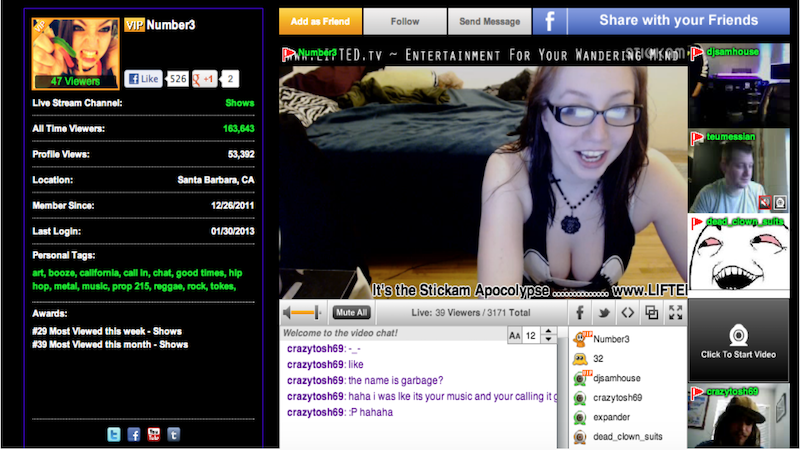
Stickam’s features, now considered standard, were groundbreaking in the mid-2000s.
-
🎥 “Go Live” in Seconds: one click let any webcam—or later, any iPhone or iPad—beam a public stream without delay.
-
📷 Interactive Video Chat: hosts could place up to six guest cameras beside their own, turning the sidebar into a moving party grid that felt like a living room online.
-
🥳 Social & “Fangating”: early Facebook and Twitter log-ins appeared here first, and creators could lock streams behind a “follow me on Twitter” gate, turning viewers into followers before they watched.
-
🔀 Stickam Shuffle: the 2010 update paired strangers at random, beating Chatroulette to the punch and giving users a quick dose of serendipity.
-
👥 High-Profile Partnerships: MTV, G4, and Levi’s streamed events here, while Underoath and Smashing Pumpkins ran live studio sets and off-beat shows. 🎸
The Culture & The Controversy: A Double-Edged Sword
Open doors invited creativity, yet they also brought danger. Stickam became a playground for teens testing online identities, but the same freedom carried obvious risks.
Safety talk trailed the site from day one. A minimum age of fourteen and a small admin crew could not police every room; the breaking point came in 2010 when an eleven-year-old dubbed “Jessi Slaughter” endured vicious cyber-bullying. The backlash forced a public “zero tolerance” pledge toward predators and harassment.
Later, press reports tied Stickam’s parent firm to adult networks, hinting at shared staff and data. Headlines linking “Stickam teens” and “Stickam girl” quickly overshadowed the platform’s early glow.
The Fall: Why Did Stickam Shut Down?
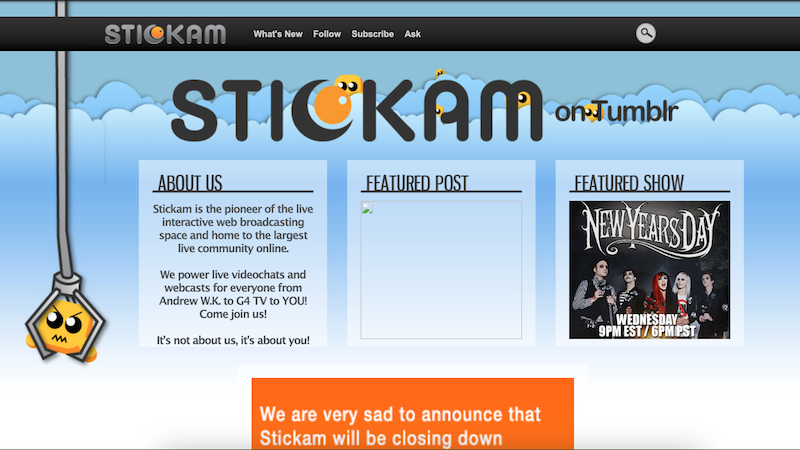
On January 30, 2013, a short, somber post appeared on the official Stickam blog titled “Stickam Closing.” Services ended the next day. The post thanked users but offered no detailed explanation. So, why did Stickam shut down? The truth lies in a convergence of critical factors:
-
The Tech Tide Turned 📱
The web was abandoning Flash for mobile-friendly HTML5. Stickam’s core technology became a relic. Meanwhile, user behavior shifted from desktop to smartphones, a transition Stickam couldn’t master.
-
The Giants Awoke 🏔️:
By the early 2010s, YouTube’s live button had arrived, Facebook was everywhere, and Twitter was gaining speed; each offered huge built-in crowds and polished back-ends, so a separate video hub suddenly felt antique.
-
The Business Model Leaked 💸:
Sustaining millions of video streams is astronomically expensive. Advertising revenue likely couldn’t cover the bills, especially as brand-safe advertisers grew wary of the platform’s controversial reputation.
-
The Scars of Scandal 🩹:
The relentless negative press around safety created an existential crisis. It scared away partners, reduced the user base, and prevented the brand from being restored. It’s conceivable that the expense of legal supervision and moderation become unaffordable.
It wasn’t one blow, but a cascade. Stickam pioneered the market, then was overwhelmed by the very wave of innovation and scale it helped start.
Conclusion
Stickam’s arc is a textbook dot-com parable: it arrived early, sketched the blueprint for creator-led live streams, then buckled under shifting technology, fiercer rivals, and its own safety missteps.
Its shutdown created a vacuum that newer platforms fill today with sharper code and sturdier guardrails. We can’t revisit the original streams, but we can credit the service for proving—well ahead of its time—that life on the internet is best experienced live.
Frequently Asked Questions
-
What is Stickam?
Stickam was a pioneer live-video site that opened in 2005, letting anyone broadcast solo or host a split-screen chat for up to six guests, then embed the stream elsewhere.
-
When did Stickam come out?
The platform officially launched in February 2005 and operated for nearly eight years before shutting down.
-
Why did Stickam shut down?
Stickam ceased all services on January 31, 2013. Its closure resulted from a combination of factors: outdated Flash-based technology, intense competition from major social media platforms, insurmountable challenges in monetizing its service, and persistent negative publicity stemming from safety controversies and cyberbullying incidents.
-
Was Stickam mainly for random video chat?
Not exactly. While it had a “Shuffle” feature for random connections, Stickam was primarily a social network built around persistent identities and live profiles. Its core was about broadcasting to your friends and followers or hosting themed chat rooms, not just anonymous 1v1 Video Chat.
-
What were the major controversies surrounding Stickam?
Headlines zeroed in on weak safety controls after the 2010 “Jessi Slaughter” cyber-bullying case involving an eleven-year-old. Later stories tied the parent firm to adult sites, feeding doubts about how vigorously the company shielded its teen-heavy audience.
-
What are the best modern alternatives to Stickam?
The live-streaming landscape Stickam pioneered is now thriving. For social live streams, Twitch (gaming/creative) and TikTok Live are dominant. For video chat, newer platforms like Pink Chat offer modern interfaces and safety features. For the random chat aspect, sites like Chatroulette or Chatliv continue that specific tradition.